Silent Casters for Hospital Beds
The Comprehensive Guide for Silent Casters in Hospital Beds and Medical Equipment
In a hospital, it is the little details that count in the care for the patients. It is of utmost necessity to be able to transport the equipment with ease. Noisy or faulty casters are not just small problems. They can really impair the work of the staff and the recovery of patients. This guide covers the most important characteristics and types, as well as how to choose silent casters for hospitals.
.png)
Key Takeaways* Silent casters are directly related to the comfort of the patient. A drag on the healing process may come from the noise stress. * A softwheel that is quiet is usually of TPR material. It also needs a good ball bearing and a robust housing. * The equipment in question requires the different types of casters. Beds need central locking. Carts need total lock. Electronics need ESD casters. * During purchase, it is important to check weight limits and mounting type. Besides these two, one also needs to check the wheel size and chemical resistance. * The regular check and proper cleaning are the main sources of silence and safety in casters for a long time.
Quiet and Reliability: Must Have Qualities
Good medical casters have another ability. They help in the provision of better patient care. The right casters affect patients, staff, and budgets.
A quiet hospital speeds up the healing process for the patients. Research indicates that the range of sounds detected in hospitals is frequently too high. The World Health Organization has noise standards which define a barraging noise. Most of the hospitals outbid these standards. One more problem is loud devices and creaky casters that add the noise factor. The stress caused by this noise and the lack of rest bed down the patients' recoveries. The utilization of silent casters in the hospital assures complete trust and sounds-less environment.
Smooth casters also act as a kind of safeguard for the involved personnel. The nurses and technicians are the ones constantly pushing and pulling heavy beds and equipment. Bad casters mainly increase the hassle and this work becomes much harder. They elevate the risk of physical injuries like back pain and tendon injuries. So it is fair to say that good casters need less power to move equipment. This is how it becomes safe and easy for everyone.
These special rolling parts are the safest means for expensive machines as well. A short product of a cheap caster can displace the highly sensitive equipment. The shock-absorbing ones run smooth and are the best solution. They ensure the transportation security of ultrasound machines and patient monitors.
The fact that cleanliness is the top priority in hospitals cannot be overstated. Caster wheels must be easy to clean. They need to withstand strong cleaning materials. These casters for hospital beds are plasticized for this purpose. They decrease the chances of spreading germs.
The Composition of a Silent Caster
What makes a caster really silent and smooth? It is not solely one element, but more. Several key elements must be in perfect operation together. The knowledge about these elements will help you buy the correct casters for hospital beds.
Wheel Material: The First Step to Silence
The most critical part for quiet rolling is the material of the wheel. The softness of the material has an impact on noise and floor protection. This term for that softness is known as durometer. The softer the wheel is, the more it absorbs the bumps and the quieter it rolls.
-
Thermoplastic Rubber (TPR): is the first choice for quiet movement. It is a great floor protector. It is resistant to most cleaning chemicals. It is the best choice for many medical casters.
-
Soft Polyurethane: is the alternative option available. It is a quiet wheel, but it has a harder formulation compared to TPR. It is able to roll smoothly and withstand heavier loads. It is perfect for heavy-duty casters on medical equipment.
-
Neoprene Rubber: is the material that offers maximum cushioning and shock absorption. It is mainly for carts that are equipped with sensitive and expensive electronics.
.png)
Bearing Precision: The Secret to Effortless Rolling
Bearings are tiny components which allow the wheels and swivels to turn. Having the quality of the bearings is essential. Normal casters have simple bearings which may wear out, cause squeaking, and add to the pushing difficulty of the equipment.
The use of silent casters for hospital purposes is based on the ceramic ball bearings. The bearings are installed in both the wheel hub and the swivel section. They allow the caster to roll and turn easily. You will not exert much effort when you push a cart with precision bearings. It glides without a sound across the floor. Rattling or squeaking do not take place. There lies the main distinction between a high-performing medical caster and an ordinary one.
Housing and Construction: The Foundation of Strength
The caster housing is the element that unites everything. For medical purposes, the housings are made from sturdy materials. They are mostly made of glass-reinforced nylon and stainless steel. They are highly functional in regard to long-life span and resistance to chemicals.
The good housing has threading guards as well. These are the protective covers fitted on the wheel side. They act as a barrier against hair, threads, and other items that can wrap around the axle. This blocking of items constitutes one of the major problems causing casters to jam and become noisy. The lack of hair and other loose agents means the thread will not be damaged long term. These thread guards are an essential part of the thread lock casters.
A Practical Guide: Matching Caster Types to Medical Applications
Different medical equipment serves different needs. Selecting the suitable caster function is as vital as selecting materials. Below is a guideline for docking casters that are used in a specific hospital area.
For Hospital Beds & Stretchers: Central Locking Casters
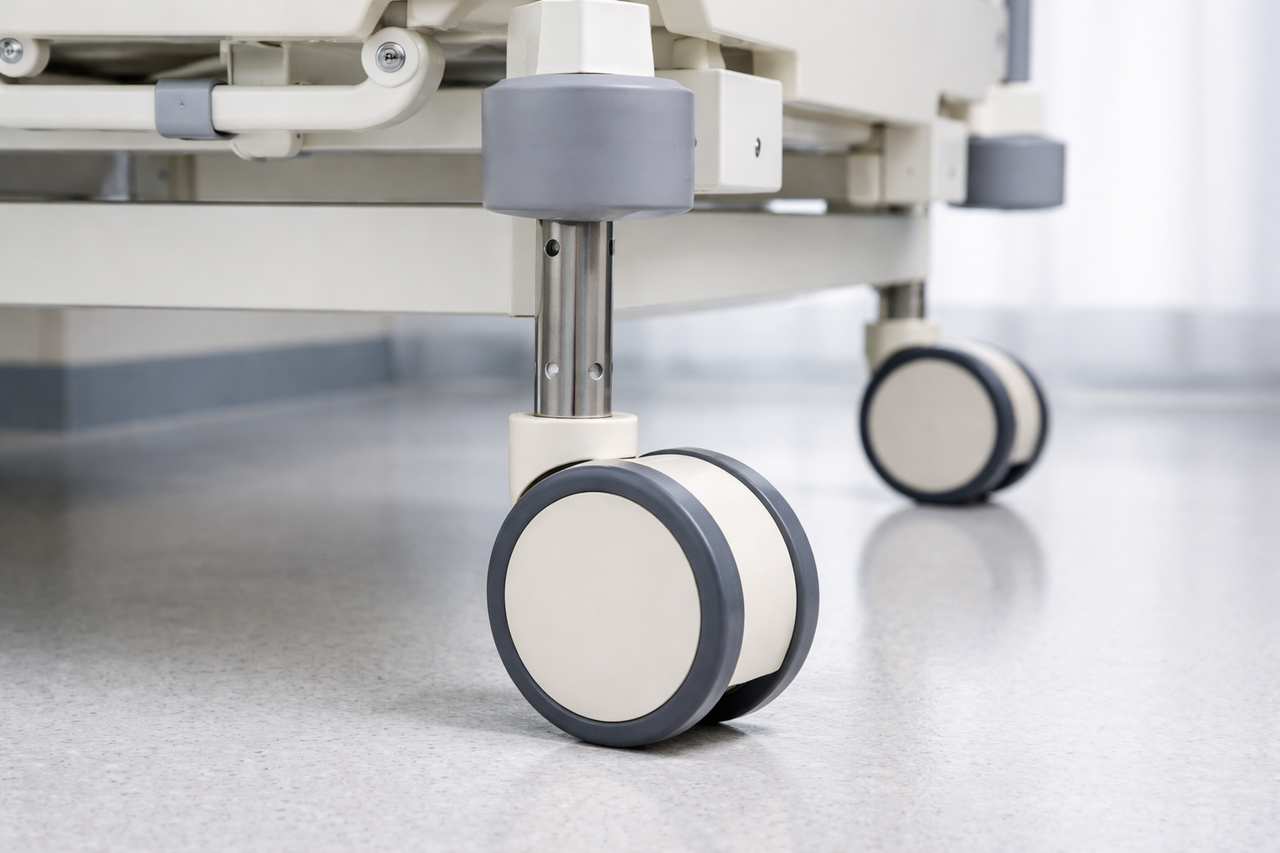
The patient Comes First in hospitals, so the same is true with the beds that they are in. So these beds have specialized set up casters. The system is a central locking one. The nurse or doctor locks or unlocks all the four wheels together with one foot pedal. This makes fastening the bed quick and dependable.
Many casters for hospital beds come with a directional lock that inhibits swaying. Such features lock a caster making it immobile. Thus, it keeps the caster straight. This makes it easier to guide the long bed through the hallway. Systems like EDL Medical Using Medium 5inch Caster E57165H-E575-77 are a good example of this. They are dual technology used for medical beds.
For IV Poles & Carts: Total Lock Swivel Casters
Mobile carts, for example, IV poles, and other equipment must move easily in tight spaces. A full 360 -degree swivel caster is best for this. It allows the cart to turn in any direction.
For safety, these often use a total lock brake. The total lock will first and foremost be responsible for braking. But simultaneously it will be turning off the swivel function. Preventing the cart from moving when it is not so desired is the aim of this action.
For Specialized Areas: MRI-Safe and Stainless Steel
Some hospital areas have unique needs. MRI rooms have powerful magnets. Any equipment used in these rooms must be free of magnetic metals. MRI-safe casters are made from special polymers and non-magnetic metals.
For areas with frequent, high-temperature washing or harsh chemicals, stainless steel casters are ideal. Stainless steel will not rust or corrode. This makes it perfect for the toughest cleaning routines.
Your Pre-Purchase Checklist: 5 Key Factors
When you are ready to make a purchase for casters for hospital beds or other equipment, this simple checklist can be useful. It will allow you to make sure all the necessary details are attended to.
-
Load Capacity
-
Action: The first thing is to calculate the total weight of your equipment, including the weight of the patient. Divide this number by three. This gives you a safety margin for the case, where one of the support points is not on the same level. In this respect, the caster's dynamic load rating must be more than this number.
.png)
-
Mounting Type
-
Action: Check what the mounting of the old caster was like. Was it a stem thread or a stem grip ring smooth? Is it a flat top plate with bolt holes? You may need to know the stem length and diameter or the plate size and spacing of holes that you require an exact match.
-
Wheel Diameter
-
Action: Find out where the equipment will be used. Bigger wheels generally roll easier over door thresholds and gaps in elevators. They can also roll over small debris in the way. Bigger wheels are about 125mm to 150mm (5 to 6 inches) in diameter. Smaller wheels create a height difference and lower the center of gravity giving more stability to the equipment.
-
Environmental Resistance
-
Action: Write down the names of the cleaning chemicals your hospital regularly uses. Check if the caster's wheel and housing materials can tolerate those chemicals. Inquire if the casters need to be absolutely washable. It has been stated that modern medical casters are EDL Medical Casters. They are made from materials that handle tough hospital environments.
-
Standards and Certifications
-
Action: Look into whether the casters are conforming to the appropriate industry standards. NSF certification is a sanitation and hygiene clause. RoHS compliance is the product is not containing some specific hazardous materials. These certifications not only ensure that the product is of high quality but are also an evidence of the commitment to safety.
Maintenance and Care for a Longer Lifespan
The right care and maintenance methods will prolong the life of your casters for medical equipment. Following a simple care regime will help the wheels to be quiet and safe for a long time.
Recommended Inspection Schedule
-
Weekly: Check each caster for hair, sutures, or threads wrapped around the wheel axle. Any found debris should be removed.
-
Monthly: Examine and test every brake and lock. Ensure that they are solidly engaged and restraining balance.
-
Quarterly: Clean both the wheels and housings with a recommended cleaner. This will prevent performance-affecting buildups.
Cleaning Best Practices
-
Do: Use hospital-grade disinfectants that are approved for the caster's materials. These include nylon, polyurethane, and TPR.
-
Don't: Use steel wool or other abrasive pads. They can scratch and damage the wheel tread.
-
Do: Wipe the casters dry after cleaning. This stops water from getting into the bearings and causing rust.
Recognizing When to Replace a Caster
The most high-quality casters lose their properties over time. It is crucial the old and beaten caster gets replaced before it displays any hazard. The indicators of these problems are:
-
Bumps forming on the wheel. This results into a rough ride.
-
The wheel tread is cracking or has pieces breaking off.
-
You hear grinding or rattling noises. This means the bearings are worn out.
-
The brake or locking mechanism feels loose or fails to hold.
Frequently Asked Questions (FAQ)
1. What makes a caster "medical grade"?
The term "medical grade" signifies further than just using the correct materials to sanitize and being quiet and non-marking it also involves the presence of the right features such as the precision bearings and integrated thread guards, among others that are trusted to work for healthcare settings.
2. How do I measure for a replacement hospital bed caster?
There are three key measurements: 1) the diameter of the wheel, 2) the mounting mechanism-If it is a stem, measure the stem diameter and length; if it is a plate, measure the dimensions of the plate and the spacing of the bolt holes and 3) the total height from the ground to the mounting point.
3. What are ESD casters and when are they needed?
ESD (Electrostatic Discharge) casters have conductive properties that prevent the buildup of static electricity and safely discharge it to the ground. They are essential for carts and equipment used to transport or house sensitive electronic components, such as diagnostic machines or computer workstations, to prevent damage from static shock.
4. Can I make my existing casters quieter?
Sometimes. The first step is to thoroughly clean the wheels and axles to remove any entangled hair or debris. If the noise persists, it's likely due to worn-out bearings or wheel material. In most cases, especially with sealed precision bearings, replacement is a more effective and reliable solution than attempting repair.
5. What is a central locking caster system?
A central locking system is a mechanism on a hospital bed or stretcher that allows a healthcare worker to lock or unlock multiple casters (often all four) simultaneously using a single foot pedal. This provides fast, reliable, and secure braking, which is critical for patient safety during transfers and procedures.
{ "@context": "https://schema.org", "@graph": [ { "@type": "FAQPage", "mainEntity": [ { "@type": "Question", "name": "What makes a caster "medical grade"?", "acceptedAnswer": { "@type": "Answer", "text": "A "medical grade" caster is specifically designed for healthcare environments. This typically means it is quiet, non-marking, constructed from materials that resist chemicals and allow for easy sanitization, and often includes features like precision bearings and integrated thread guards." } }, { "@type": "Question", "name": "How do I measure for a replacement hospital bed caster?", "acceptedAnswer": { "@type": "Answer", "text": "You need to measure three key things: 1) The wheel diameter. 2) The mounting mechanism—if it's a stem, measure the stem's diameter and length; if it's a plate, measure the plate dimensions and the bolt hole spacing. 3) The overall height from the floor to the mounting point." } }, { "@type": "Question", "name": "What are ESD casters and when are they needed?", "acceptedAnswer": { "@type": "Answer", "text": "ESD (Electrostatic Discharge) casters have conductive properties that prevent the buildup of static electricity and safely discharge it to the ground. They are essential for carts and equipment used to transport or house sensitive electronic components, such as diagnostic machines or computer workstations, to prevent damage from static shock." } }, { "@type": "Question", "name": "Can I make my existing casters quieter?", "acceptedAnswer": { "@type": "Answer", "text": "Sometimes. The first step is to thoroughly clean the wheels and axles to remove any entangled hair or debris. If the noise persists, it's likely due to worn-out bearings or wheel material. In most cases, especially with sealed precision bearings, replacement is a more effective and reliable solution than attempting repair." } }, { "@type": "Question", "name": "What is a central locking caster system?", "acceptedAnswer": { "@type": "Answer", "text": "A central locking system is a mechanism on a hospital bed or stretcher that allows a healthcare worker to lock or unlock multiple casters (often all four) simultaneously using a single foot pedal. This provides fast, reliable, and secure braking, which is critical for patient safety during transfers and procedures." } } ] }, { "@type": "Person", "name": "" } ] }